An Old Fashioned Approach to ADHD
If I wasn’t a therapist, I have joked that I would want to be a neuroscientist. The brain fascinates me, and it also unnerves me a bit knowing I don’t utilize it anywhere near its full capacity.
I happen to have a love/hate relationship with technology. For instance, I appreciate being able to work with clients virtually when necessary, and yet I prefer in-person sessions. I also prefer the pen-to-paper method of writing - it works so much better for my brain. I notice the creativity flows easier and focus is much more sustained. I can write this blog post so much quicker when I start it out on paper vs. staring at a computer screen for what feels like eternity trying to get the creative flow going and instead being met with a growing frustration.
Studies will support this individual experience. Neuroimaging of the brain has shown how the physical action of writing by hand stimulates certain neural pathways in the brain linked to motor, visual, and sensory areas which allows for increased creative thinking, problem-solving, and reduced distraction.
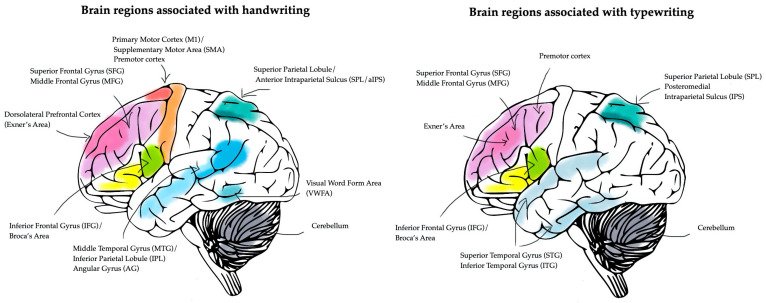
Marano G, Kotzalidis GD, Lisci FM, Anesini MB, Rossi S, Barbonetti S, Cangini A, Ronsisvalle A, Artuso L, Falsini C, Caso R, Mandracchia G, Brisi C, Traversi G, Mazza O, Pola R, Sani G, Mercuri EM, Gaetani E, Mazza M. The Neuroscience Behind Writing: Handwriting vs. Typing-Who Wins the Battle? Life (Basel). 2025 Feb 22;15(3):345. doi: 10.3390/life15030345. PMID: 40141690; PMCID: PMC11943480.
We see in Figure 1 above how the Primary Motor Cortex area of the brain lights up when we engage in the practice of handwriting and how the Prefrontal Cortex (PFC) lights up brighter as well. The PFC is responsible for executive functions such as impulse control, focus, and planning. These areas are commonly hindered alongside ADHD. “The slower pace of handwriting allows more reflective and deliberate thinking, fostering creativity and critical analysis. Typing, while faster and more suited for brainstorming, often leads to a cognitive trade-off where the speed of transcription inhibits deeper thought.” (Marano et al., 2025).
Writing by hand is sometimes referred to as a “speed bump” because it requires the writer to slow down, to focus.
So, what goal do you have that perhaps handwriting can support?
Are you trying to round out nutrition and eat differently? Make a grocery list and write out 1 new recipe
Are you trying to get out of debt and better manage your money? Write out a monthly budget - see where your money is going
Are you wanting to better understand what you’re feeling? Start journaling
Are you wanting to exercise more? Track your days on a physical calendar
Are you wanting to drink more water? Keep a physical water log for a week
Are you wanting to write a book or a blog? Start on paper
Around the office at Still Waters, clients will start to see a lot more individual journals ready for use! I am excited to test out this experience even further in supporting clients toward meeting their goals because I understand that good mental health is connected to all the other domains of health, including physical health, social health, financial health, and spiritual health.
References:
Marano G, Kotzalidis GD, Lisci FM, Anesini MB, Rossi S, Barbonetti S, Cangini A, Ronsisvalle A, Artuso L, Falsini C, Caso R, Mandracchia G, Brisi C, Traversi G, Mazza O, Pola R, Sani G, Mercuri EM, Gaetani E, Mazza M. The Neuroscience Behind Writing: Handwriting vs. Typing-Who Wins the Battle? Life (Basel). 2025 Feb 22;15(3):345. doi: 10.3390/life15030345. PMID: 40141690; PMCID: PMC11943480.